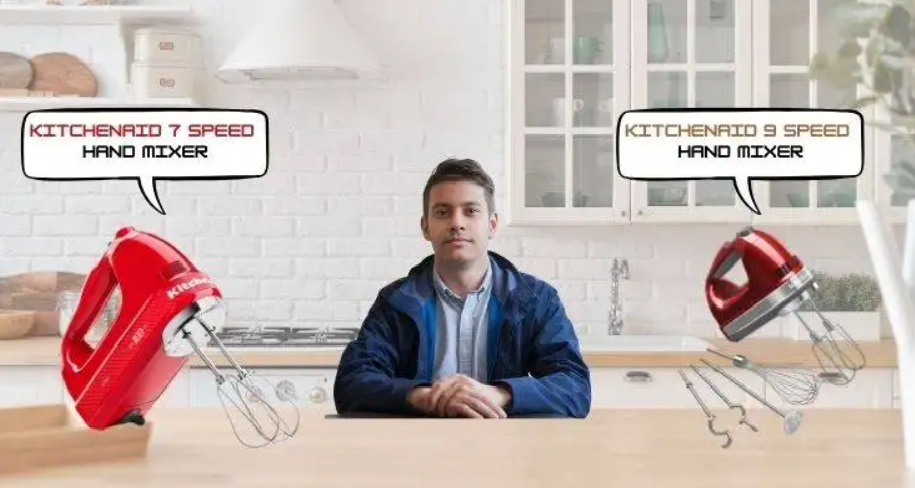
When you dive into the world of home baking and efficient kitchen prep, a hand mixer quickly becomes one of the most-used small appliances in your kitchen. Two popular options from one of the most trusted brands are the KitchenAid 7-speed hand mixer and the KitchenAid 9-speed hand mixer. On paper these models look similar: both carry the KitchenAid name, sturdy build quality, and a reputation for reliability. But a closer look reveals meaningful differences in power delivery, speed options, attachments, ergonomics, and price — factors that can affect which one fits your baking style and budget.
This comprehensive article covers everything you need to know before buying: a head-to-head comparison of features, detailed breakdowns of performance, real-world user scenarios, pros and cons, buying tips, accessories and attachments, maintenance advice, common problems and fixes, and frequently asked questions. Whether you’re a casual baker, a meal-prep enthusiast, or planning to run a micro bakery from home, by the end of this guide you’ll know exactly which KitchenAid hand mixer is the smarter buy for you.
Table of Contents
- Quick summary: Which to choose?
- Brand background: KitchenAid in handheld mixers
- Model overview: 7-speed and 9-speed at a glance
- Design and build quality
- Motor power and performance
- Speed ranges and what they mean in practice
- Attachments and compatibility
- Usability and ergonomics
- Noise levels and vibration
- Cleaning and maintenance
- Energy consumption and longevity
- Price and value
- Who should buy which model?
- Baking and cooking tests (mixing, whipping, kneading)
- Pros and cons summary
- Alternative hand mixers worth considering
- Buying checklist and tips for getting the best deal
- Troubleshooting common issues and fixes
- Accessories and must-have add-ons
- Warranty, service, and parts availability
- Final verdict
- Frequently Asked Questions (FAQ)
1. Quick summary: Which to choose?
If you want a simple answer:
- Choose the KitchenAid 9-speed hand mixer if you: want more precise speed control, frequently work with a wider range of ingredients (from delicate whipped cream to heavier cookie dough), or you prefer having extra mid-range speed steps for nuanced results.
- Choose the KitchenAid 7-speed hand mixer if you: want a dependable, simpler option that handles most everyday tasks with fewer speed settings, prefer a slightly lower price point, and value ease of use over micro-adjustability.
Both mixers deliver KitchenAid’s hallmark quality, but the 9-speed model offers finer speed gradations which can improve results for specific tasks. For many home bakers the 7-speed model will be perfectly adequate; pros, enthusiasts, and those who bake intensively may prefer the extra control of the 9-speed.
2. Brand background: KitchenAid in handheld mixers
KitchenAid is a long-established brand with deep roots in kitchen appliances. Known most famously for its stand mixers, KitchenAid has extended its design language and engineering into smaller handheld devices. The brand emphasizes durability, useful accessories, and a clean, functional aesthetic. Historically, KitchenAid has targeted both home cooks and prosumers — customers who want higher-than-basic performance without stepping up to commercial equipment.
For hand mixers, KitchenAid designs emphasize ergonomics, easy-to-release attachments, and balanced weight distribution. The 7-speed and 9-speed models embody this approach — both are intended to be easy to operate, clean, and maintain.
3. Model overview: 7-speed and 9-speed at a glance
Here’s a compact side-by-side overview of core specs you’ll repeatedly see mentioned:
- Speeds: 7 vs 9 discrete speed settings
- Motor power: Typically similar range; KitchenAid often uses compact but efficient DC motors in most hand mixers (exact wattage varies by specific SKU and region)
- Attachments: Both typically include standard beaters and possibly dough hooks; some packages include a whisk or splatter guard depending on retailer
- Construction: Plastic housing with metal internal components; solid feel consistent with mid-range hand mixers
- Weight: Light to moderate (one-hand operation), usually between ~1.2–1.6 lbs (manufacturers list in grams/ounces)
- Warranty: Standard 1-year limited warranty (check exact terms by region)
While hardware and motor designs are frequently shared across the two models, the primary differentiator is control: the 9-speed model’s additional steps enable more granular control of mixing intensity.
4. Design and build quality
A. Materials & finish
Both KitchenAid hand mixers use a combination of durable ABS or polycarbonate plastics for the housing and stainless-steel or nickel-plated attachments. The exterior finish is typically glossy or satin and comes in multiple colors for aesthetic personalization.
KitchenAid’s finishes are usually more refined than generic brands, with consistent seams and well-integrated buttons. The eject button for attachments and the speed slider or dial tends to be responsive and tactile.
B. Build & internal engineering
Internals are designed for everyday durability. The gearbox and motor mountings are engineered to minimize play under load. The 9-speed variant sometimes uses a marginally different gear reduction system to support additional speed steps, which can slightly affect longevity under repeated heavy loads — though in practice KitchenAid’s engineering balances the extra control with reliable mechanical design.
C. Aesthetic and color options
One advantage of KitchenAid is its palette. If matching your kitchen decor is important, KitchenAid’s color selection for hand mixers often mirrors that of its broader product line.
5. Motor power and performance
Hand mixers rely on a small but efficient motor to deliver torque through beaters. KitchenAid designs its motors to balance speed with torque, meaning they’re tuned for rapid acceleration and steady mixing performance.
- Power rating: While wattage can vary across regions and specific SKUs, most KitchenAid hand mixers fall within a range adequate for whipping creams, beating egg whites, and mixing batter. Exact wattage might be between 150–250 W for many models (always check the label for your chosen SKU).
- Torque & gearing: More important than raw wattage is the torque delivered at lower speeds. The 9-speed model’s gearing may allow for stronger low-speed torque options, making it slightly better at handling thicker batters at slower speeds without straining the motor.
- Heat management: Short, frequent use is the norm for hand mixers. KitchenAid builds thermal safeguards into the motor — but continuous heavy use (e.g., frequently kneading dough for long periods) can cause warmth. Put simply: these are meant for intermittent use, not continuous, commercial workload.
6. Speed ranges and what they mean in practice
The number of speeds affects how precisely you can control the mixing. Here’s how speed stages translate into real tasks:
- Low speeds (1–2): Incorporating dry ingredients, starting to mix flour into wet ingredients to avoid splashing.
- Low-medium (3–4): For thicker batters, cookie dough biscuit dough or initial dough kneading.
- Medium (5–6): All-purpose mixing, muffin batters, quick bread.
- High (7–8): Beating, creaming butter and sugar, mixing cake batters for aeration.
- Very high (9): Whipping cream, beating egg whites, fast aeration tasks.
With the 7-speed model, these ranges are broader: each speed covers more ground. The 9-speed model narrows the gap, giving you intermediate options, for example a distinct step between gentle folding and medium beating. This makes the 9-speed superior when you want to fine-tune consistency (e.g., avoid over-whipping whipped cream while still incorporating air).
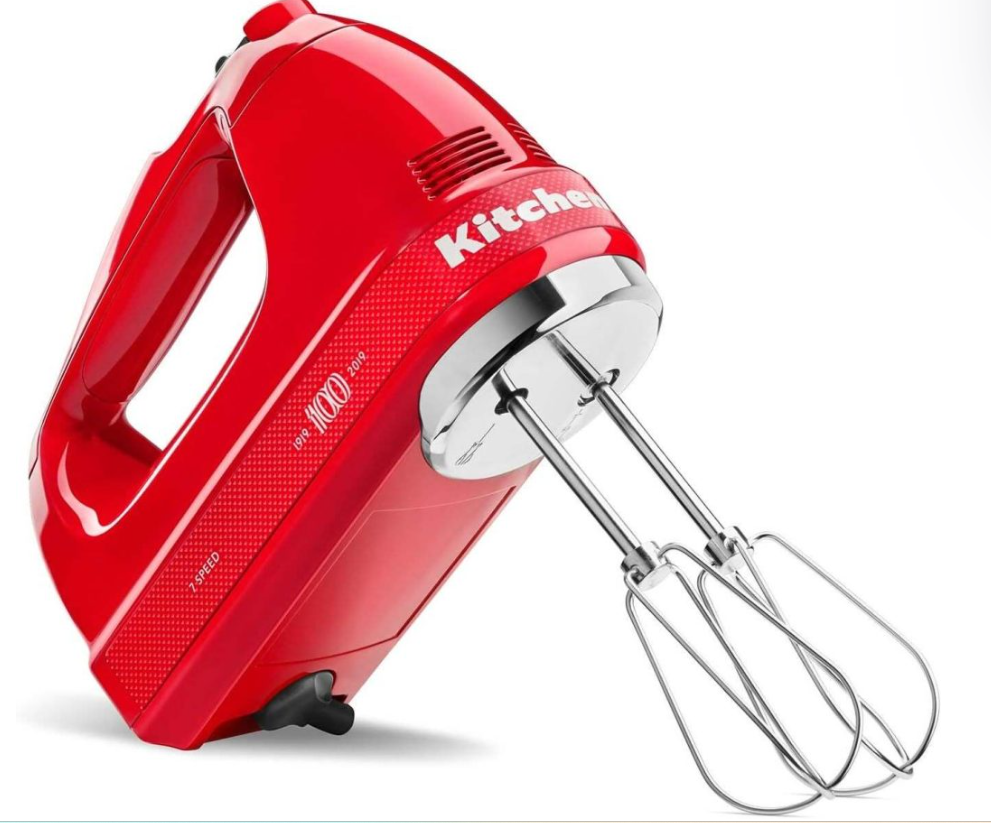

7. Attachments and compatibility
Standard attachments: Most KitchenAid hand mixers include a pair of chrome-plated wire beaters. Some packages add a whisk and dough hooks; others sell these as optional accessories.
Beaters vs whisks vs dough hooks:
- Beaters are for most batters, cakes, and cookie mixes.
- Wire whisks are better for whipping cream and egg whites because they incorporate air more efficiently.
- Dough hooks are designed to mimic the kneading motion and are best for small batches of dough.
Compatibility: KitchenAid generally maintains consistency of attachment fittings across many of its mixers, but not every accessory is universally compatible. If you already own KitchenAid attachments, check compatibility notes for the exact model number.
8. Usability and ergonomics
A. Handle and grip
KitchenAid hand mixers tend to prioritize a comfortable grip with a slightly contoured handle — they fit well in most hands and reduce fatigue during longer mixing tasks. The weight distribution is usually balanced so the unit doesn’t tip forward when held.
B. Controls layout
- The 7-speed usually provides a single slider or a row of numbered buttons for speed selection.
- The 9-speed often uses a slider with more precise indexing or a stepped dial.
The eject button for beaters is positioned for easy thumb access. Users appreciate the tactile feedback.
C. One-handed operation
Both models are designed for one-handed operation: you can hold the mixer in one hand and guide the bowl with the other. The lighter weight of a hand mixer compared to a stand mixer makes this feasible for most users.
9. Noise levels and vibration
Hand mixers are inherently louder than some high-end stand mixers because the motor is compact and close to the handling surface. However, KitchenAid’s units are reasonably quiet for their class.
- Noise: At high speeds the noise level is noticeable but not excessive — similar to other mid-range hand mixers.
- Vibration: Well-balanced beaters and internal dampening means low vibration; cheap generic mixers often vibrate more.
If noise sensitivity is important, try to test a unit in person or confirm return options with the retailer.
10. Cleaning and maintenance
KitchenAid hand mixers are generally easy to clean:
- Detach beaters and whisk: Attachments are dishwasher-safe for most models (check the manual). Wipe down the housing with a damp cloth.
- Vents: Keep motor vents free of debris. Never immerse the motor hous